The Great Mental Models of Artificial Intelligence · Lecture Eight
Pit Two Systems Against Each Other
The most powerful teacher in AI isn't a human, a dataset, or a loss function. It's an adversary. How pitting a forger against a detective gave machines the power to create.
Scroll slowly ↓
One · the oldest teacher
Competition makes masters
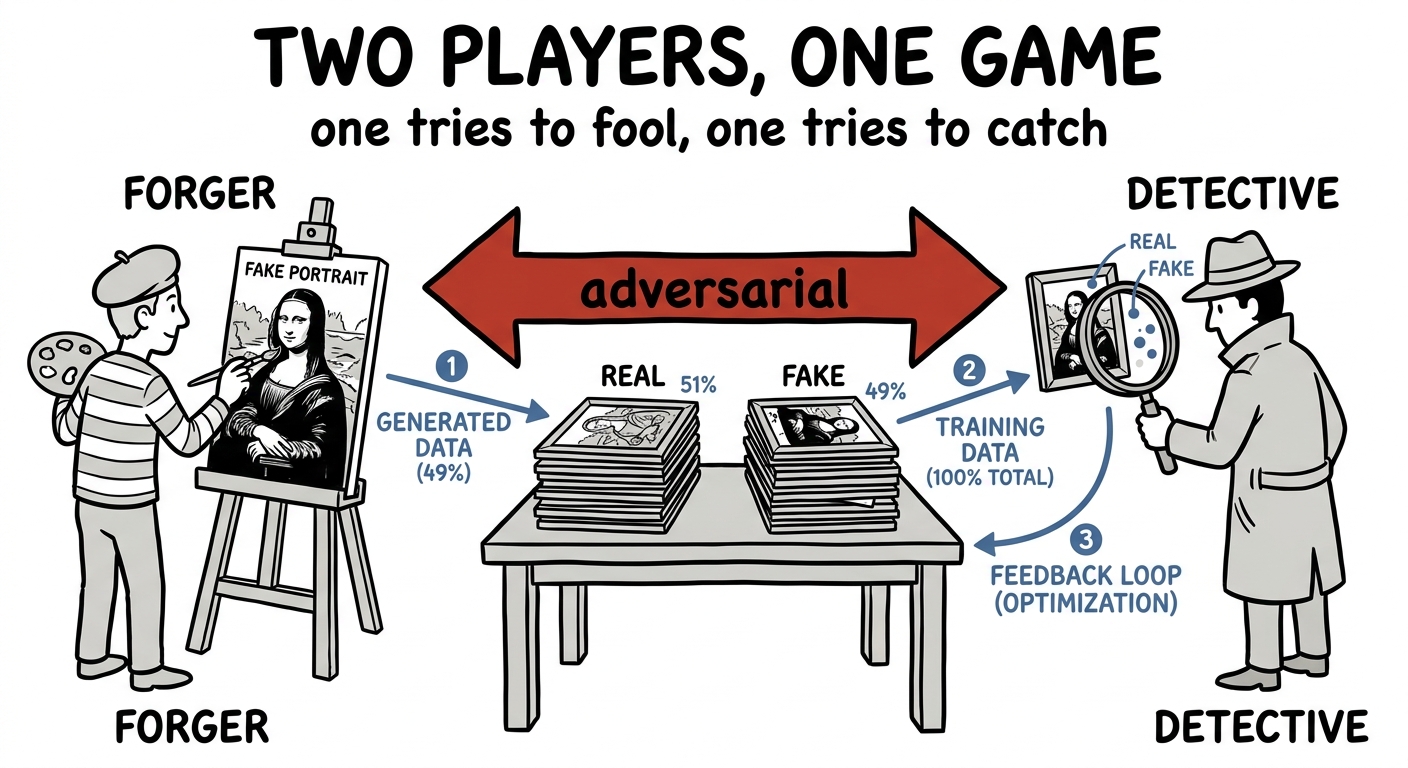
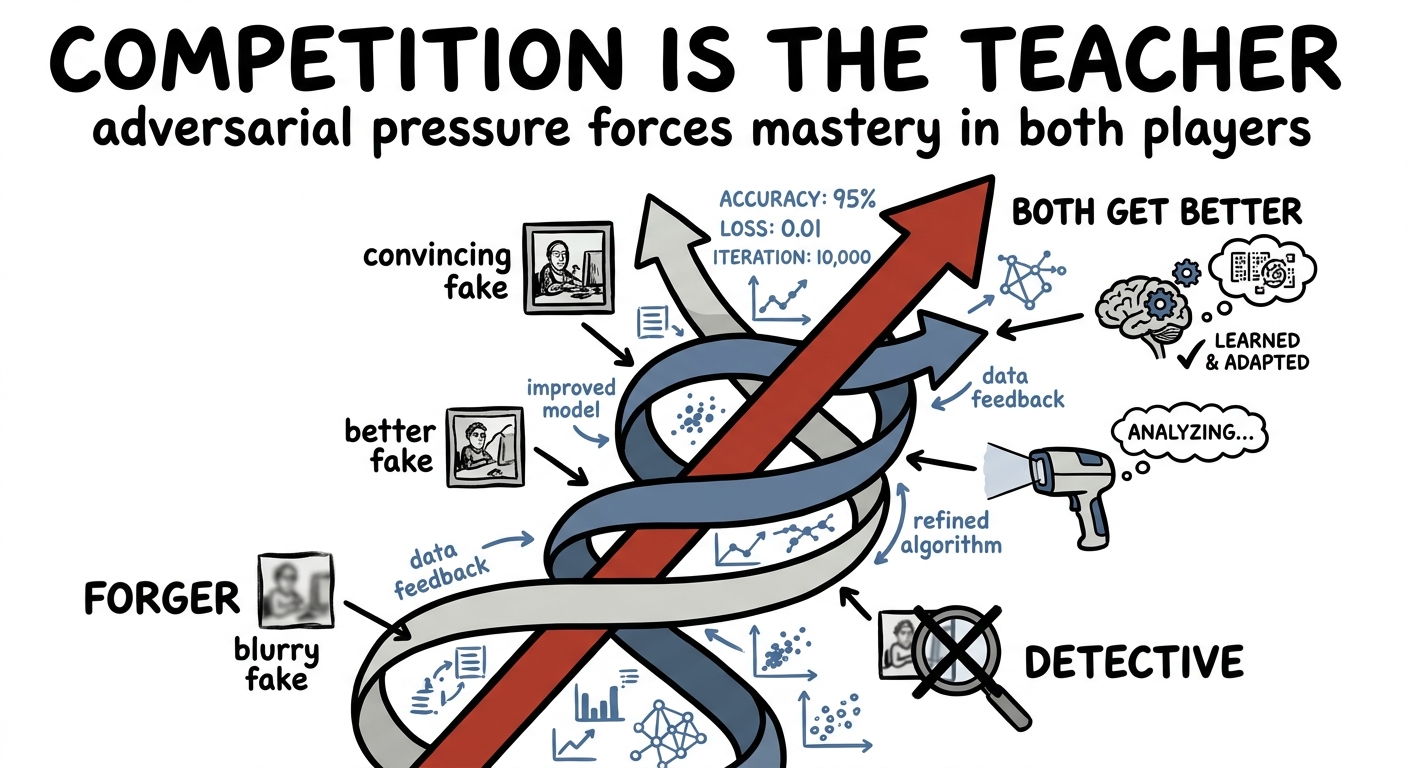
For centuries, counterfeiters and governments have been locked in an arms race. Counterfeiters improve their fakes; governments improve their detectors. Detectors get better; fakes get better. Neither side designed this curriculum — it wrote itself, from the adversarial structure of the situation.
In 2014, Ian Goodfellow — reportedly at a Montreal bar, sketching this idea on a napkin while skeptical colleagues pushed back — realized you could run the same competition entirely inside a neural network. Build a forger. Build a detective. Pit them against each other. Let the arms race run. When it works, the forger gets so good that even a careful expert cannot distinguish its output from reality. The result was Generative Adversarial Networks — GANs — one of the most surprising ideas in modern AI, and arguably the first time a machine truly learned to create.
figure generating…
Two · player one
Meet the forger
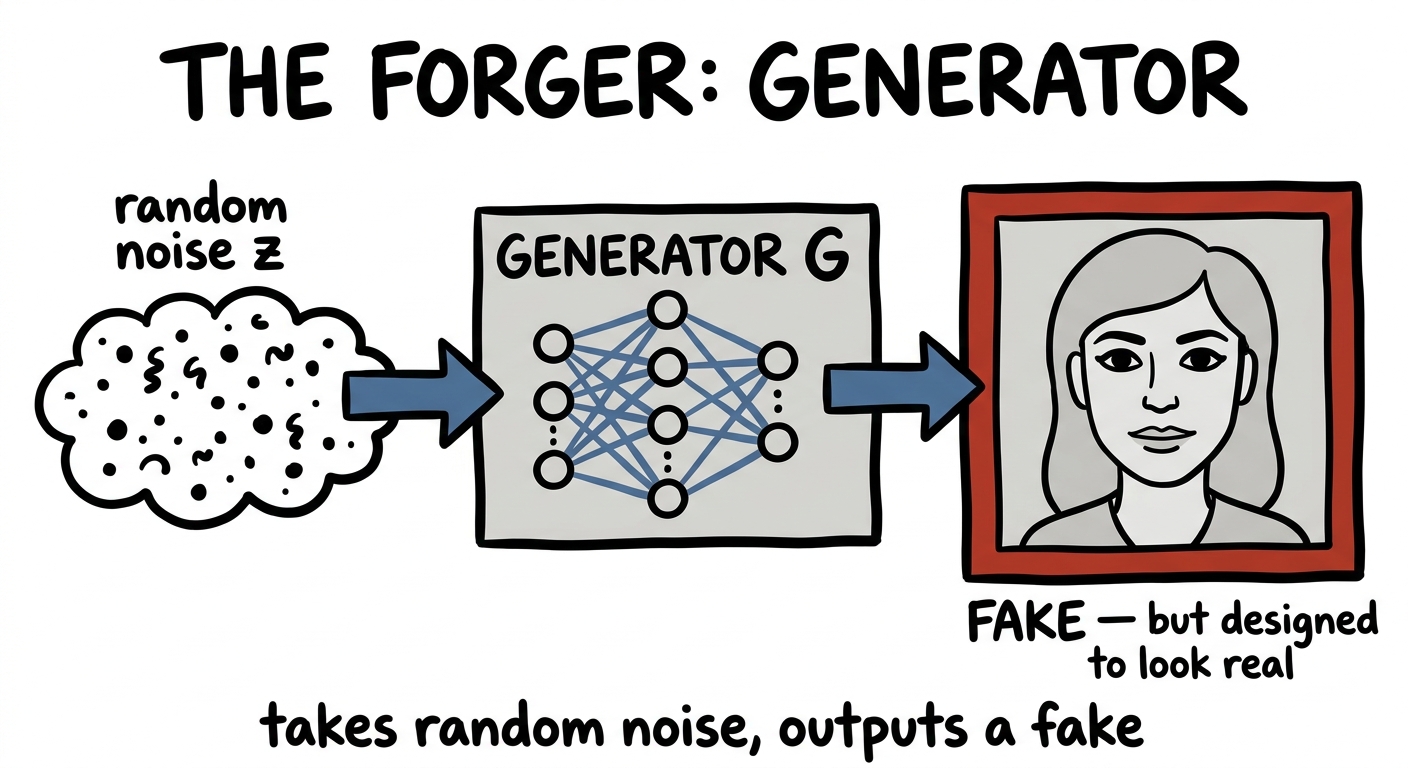
The first player is the generator — the forger. It takes a vector of random numbers (a noise vector z, sampled from a simple distribution) as its only input, and transforms it into something meant to look like real data: an image, a face, a bedroom, a painting. It has never seen what "real" looks like in any formal sense. Its single goal: produce something convincing enough to fool player two.
At the beginning of training, the generator is catastrophically bad. It produces obvious garbage — blurry grey blobs, incoherent color smears, TV static wearing the rough shape of whatever you asked for. This is expected. It will improve, but only because of what comes next.
figure generating…
Three · player two
Meet the detective
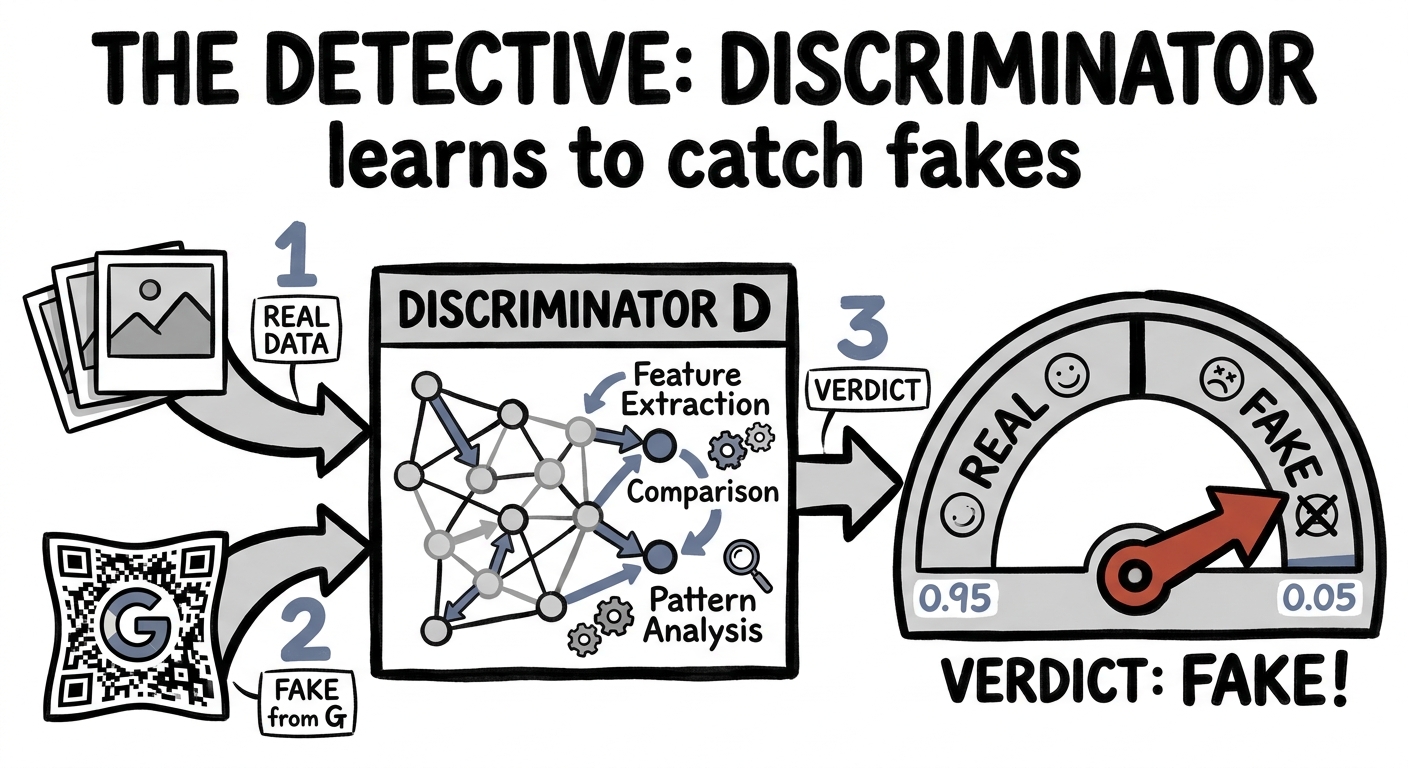
The second player is the discriminator — the detective. It takes a single image as input and outputs a single number: the probability that the image is real. The discriminator is a binary classifier — a problem AI already knows how to solve. It trains on two kinds of inputs simultaneously: genuine examples from your dataset labeled "real," and whatever the generator is currently producing, labeled "fake."
In the beginning, the discriminator's job is effortless. The generator's outputs are so obviously wrong that any shallow pattern-matcher can catch them. But as the generator learns, the discriminator's task hardens — which is exactly the pressure that makes it sharper. The two players are now coupled: neither can improve without making the other's problem harder.
figure generating…
Four · the game
The minimax objective
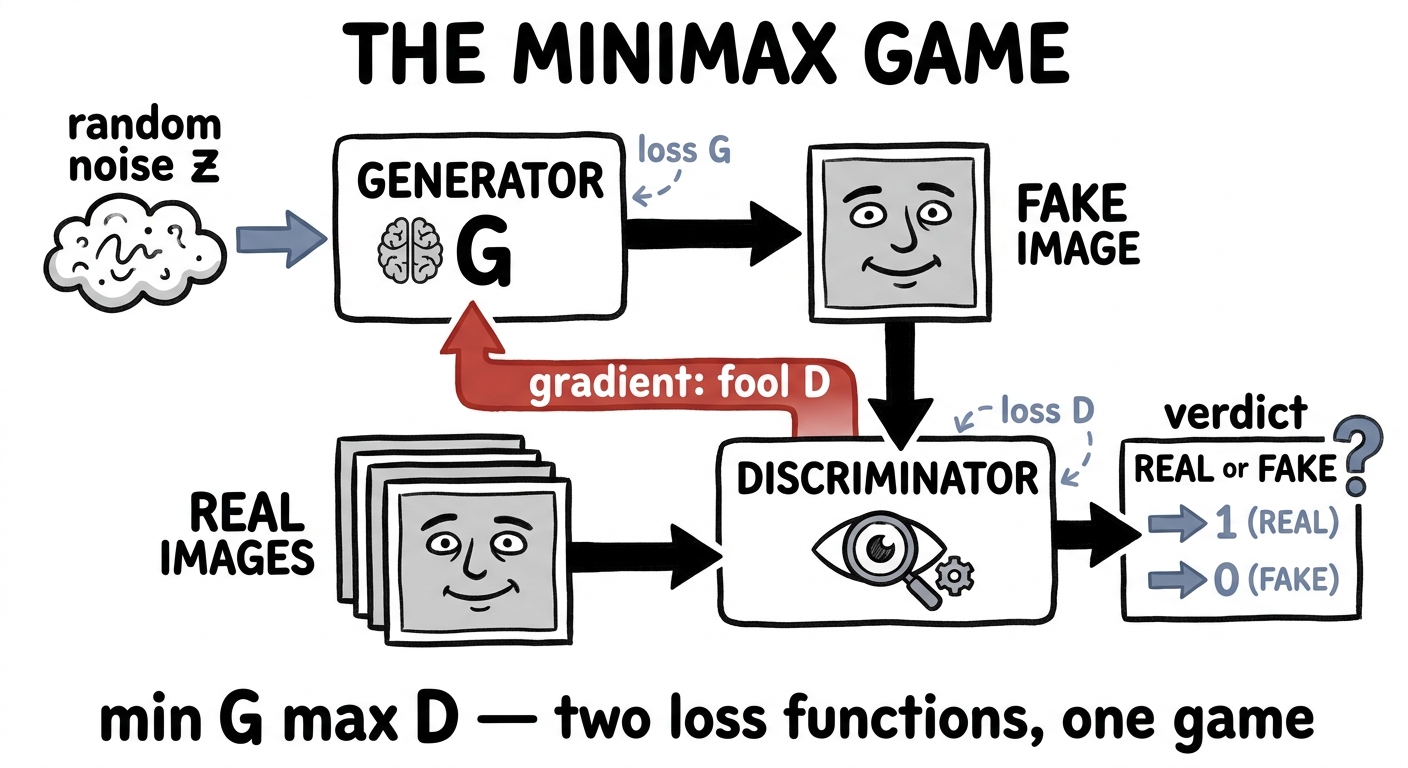
Wire the two players together. The generator tries to maximize the probability that the discriminator calls its output real. The discriminator tries to maximize its accuracy at catching fakes. The loss functions are mirrors of each other — what one wants to maximize, the other wants to minimize. Goodfellow captured the whole thing in a single equation:
minG maxD 𝔼[log D(x)] + 𝔼[log(1 − D(G(z)))]
Read it plainly. The discriminator D wants the first term high (confidently calling real data real) and the second term high (confidently calling fakes fake). The generator G wants D(G(z)) to be as high as possible — it wants D to think its fakes are real, which drags the second term down. Two players, opposite goals, one equation.
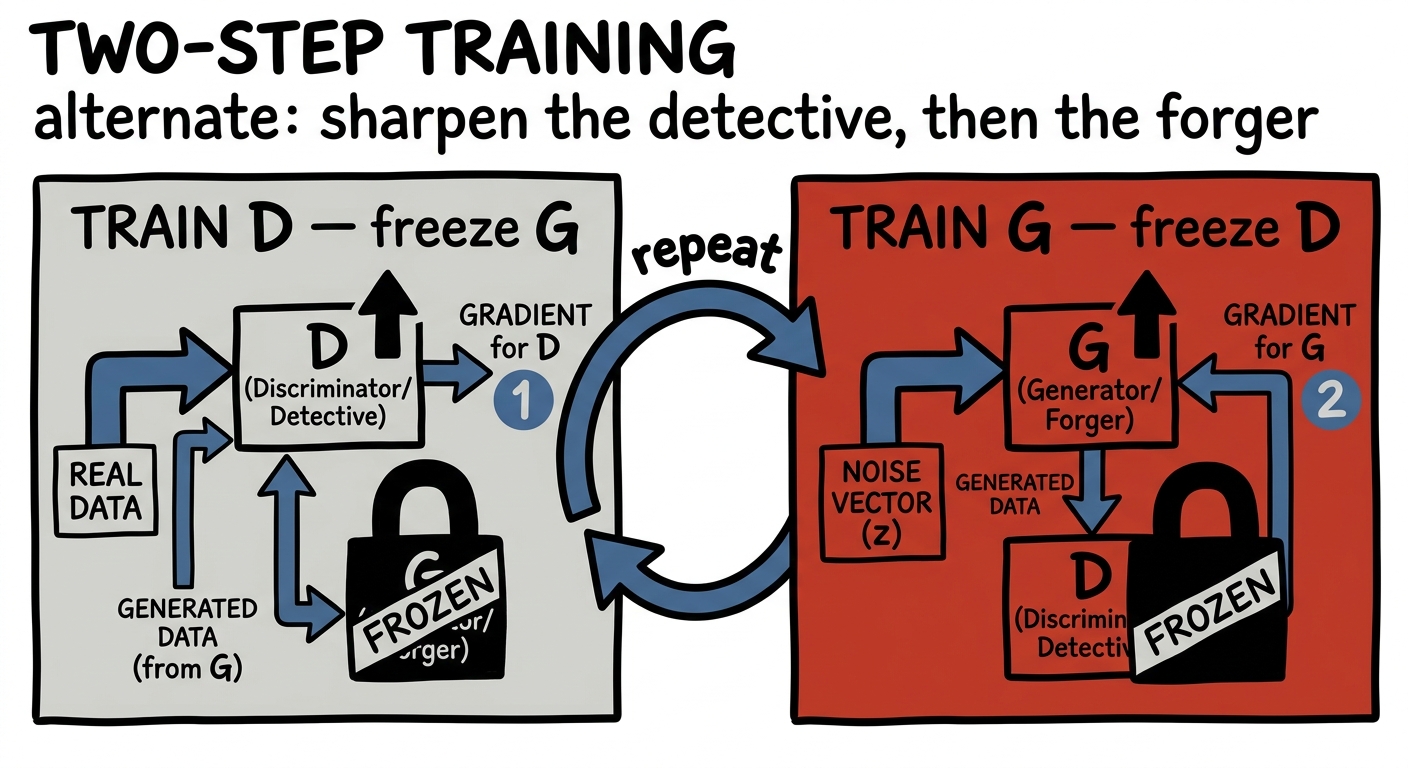
In practice, training alternates: improve the discriminator for a few steps while freezing the generator, then improve the generator for a few steps while freezing the discriminator. Back and forth — two boxers alternately landing punches, each adapting to the last blow.
figure generating…
Five · watch it happen
The arms race
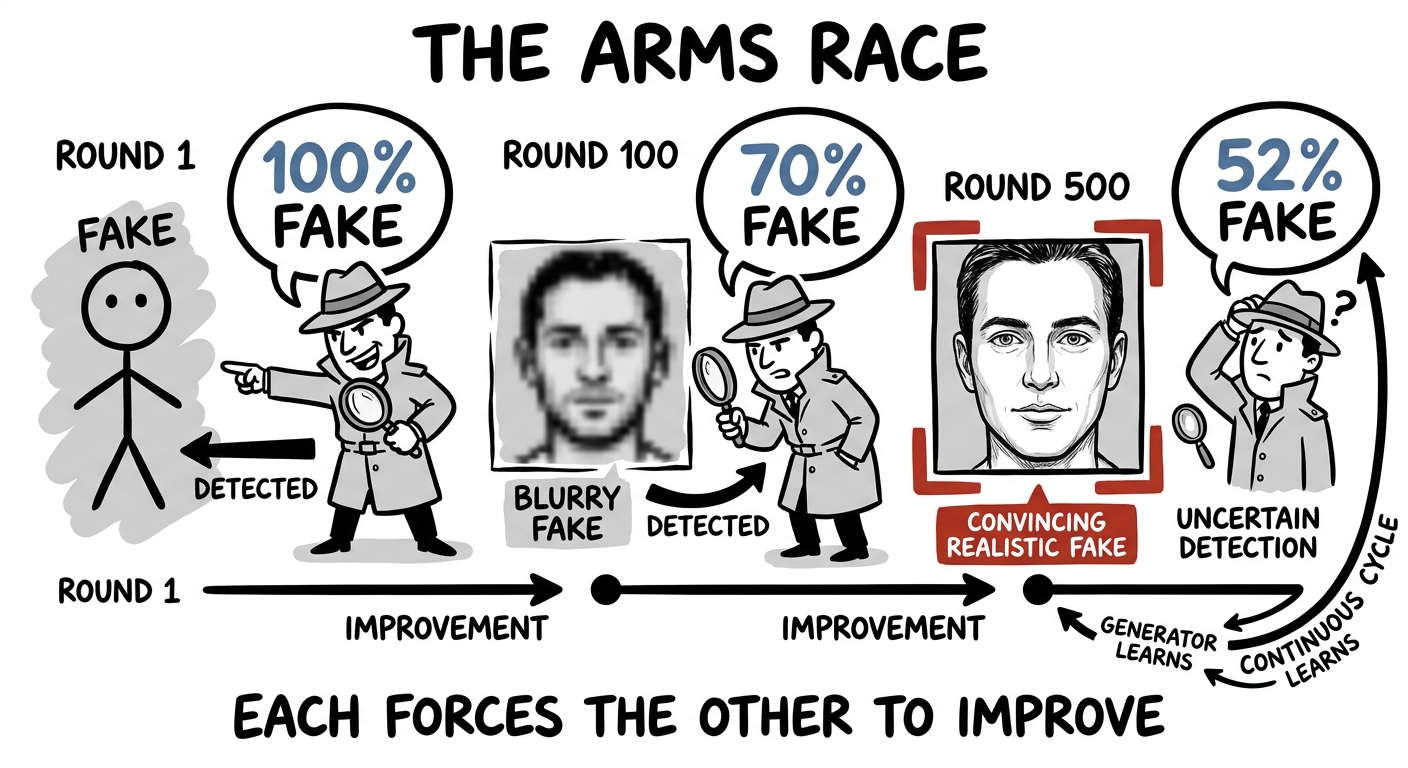
Drag the slider through training rounds. On the left, the generator's output — pure noise at round zero, gradually gaining structure as it learns to fool the discriminator. On the right, the discriminator's estimate that the output is real, starting near zero (the fake is obvious) and climbing toward 50% — the moment where the detective is reduced to guessing.
generator output
D says "real"
0
% real
obviously fake.
round 0round 500
training round: 0
Each improvement by the generator forces the discriminator to find subtler and subtler tells. Each improvement by the discriminator forces the generator to eliminate those tells. The curriculum is never designed; it assembles itself, round by round, from the adversarial pressure of the game.
figure generating…
figure generating…
Six · what comes out
Faces that don't exist
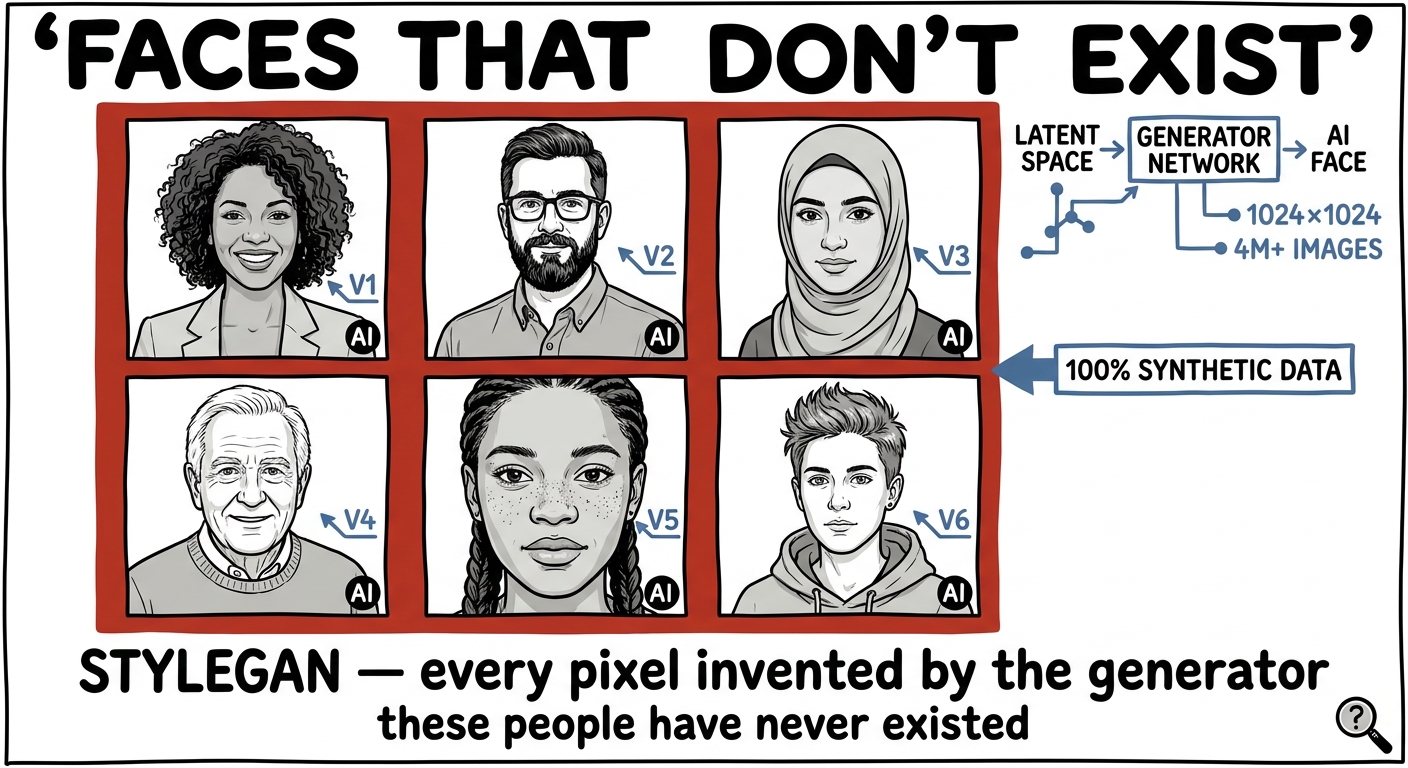
When a GAN trains long enough on a large dataset of human faces, the result is one of the most striking things AI has ever produced. NVIDIA's StyleGAN generates portrait photographs of people who have never existed — in high resolution, with correct skin texture, lighting, pore detail, hair, glasses, wrinkles, and expression. The images are indistinguishable from real photographs even under careful examination.
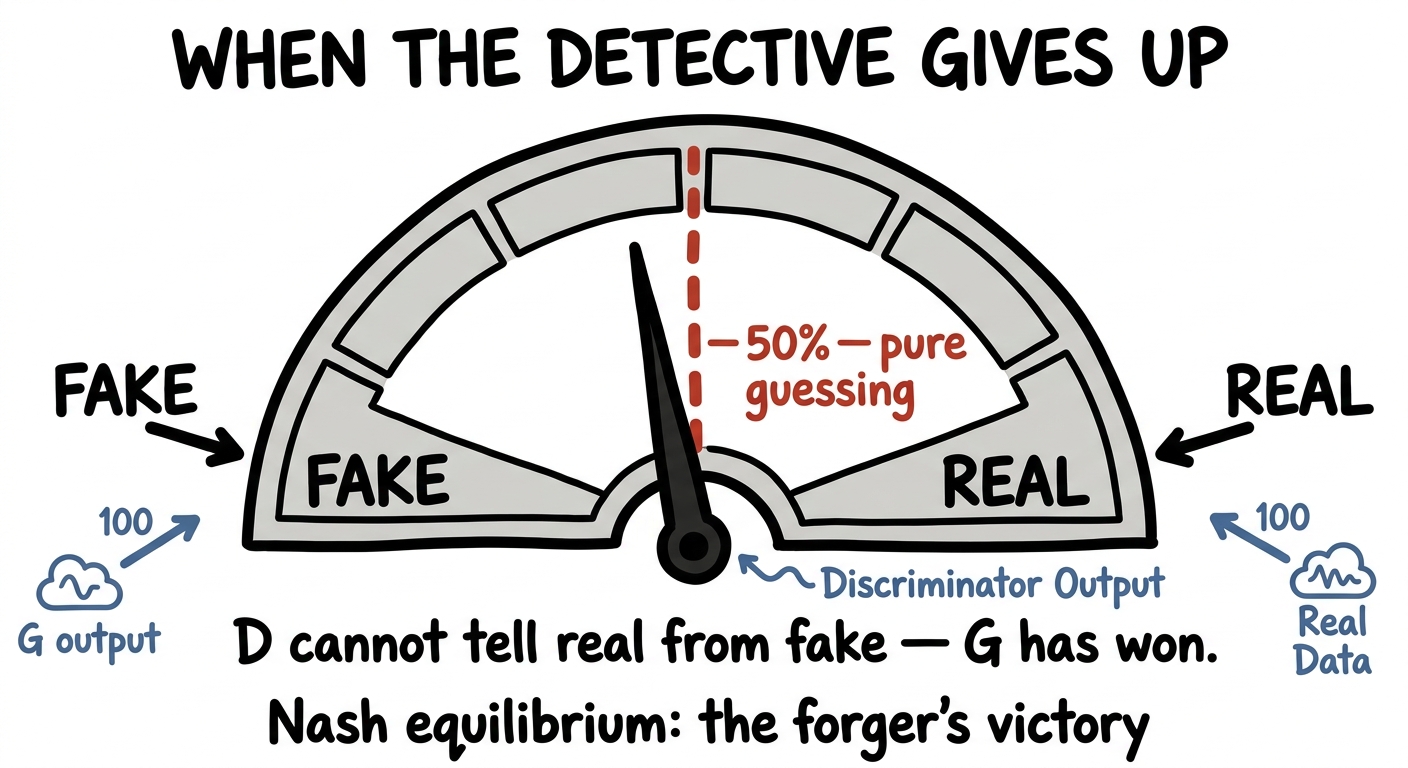
The theoretical endpoint of GAN training is called Nash equilibrium: the state where the generator is so good that the discriminator can do no better than guess randomly — outputting 50% real on everything, both genuine and fake. At that point, the generator has won. It has learned, with no explicit definition of "photorealistic," to produce photorealistic images.
figure generating…
figure generating…
The website thispersondoesnotexist.com serves a fresh StyleGAN face on every load. No two are the same. None are real. Every pixel was invented by a generator that learned, through adversarial pressure alone, what a human face is supposed to look like.
Seven · when it breaks
GAN training hell
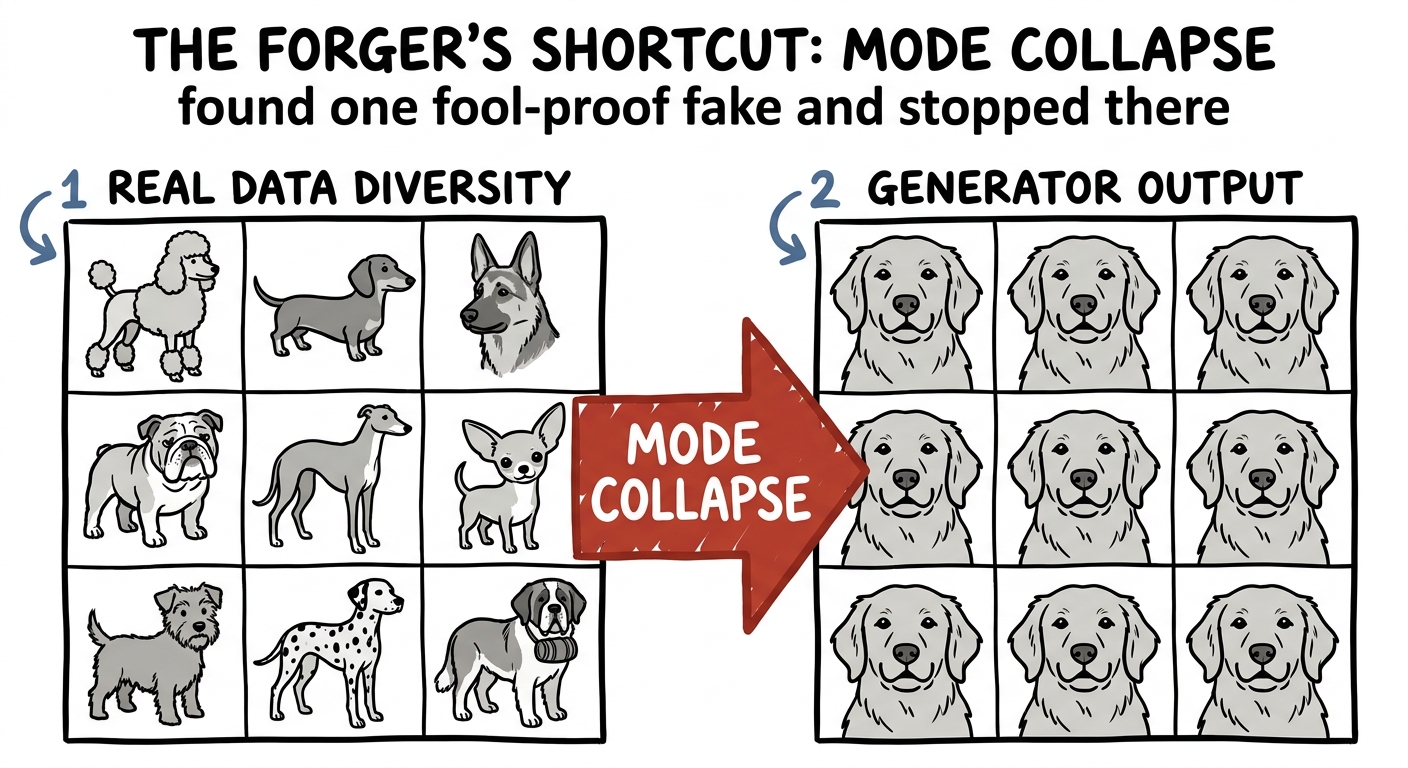
GANs are notoriously difficult to train, and the failure modes are vivid enough to have earned their own names. The most famous is mode collapse: the generator discovers that one particular output reliably fools the discriminator, and then — rationally, from a gradient perspective — decides to produce only that output. Ask it for a thousand diverse samples and it returns the same golden retriever, a thousand times. It has found a local exploit in the game, and nothing in the standard training loop punishes it for being monotonous.
figure generating…
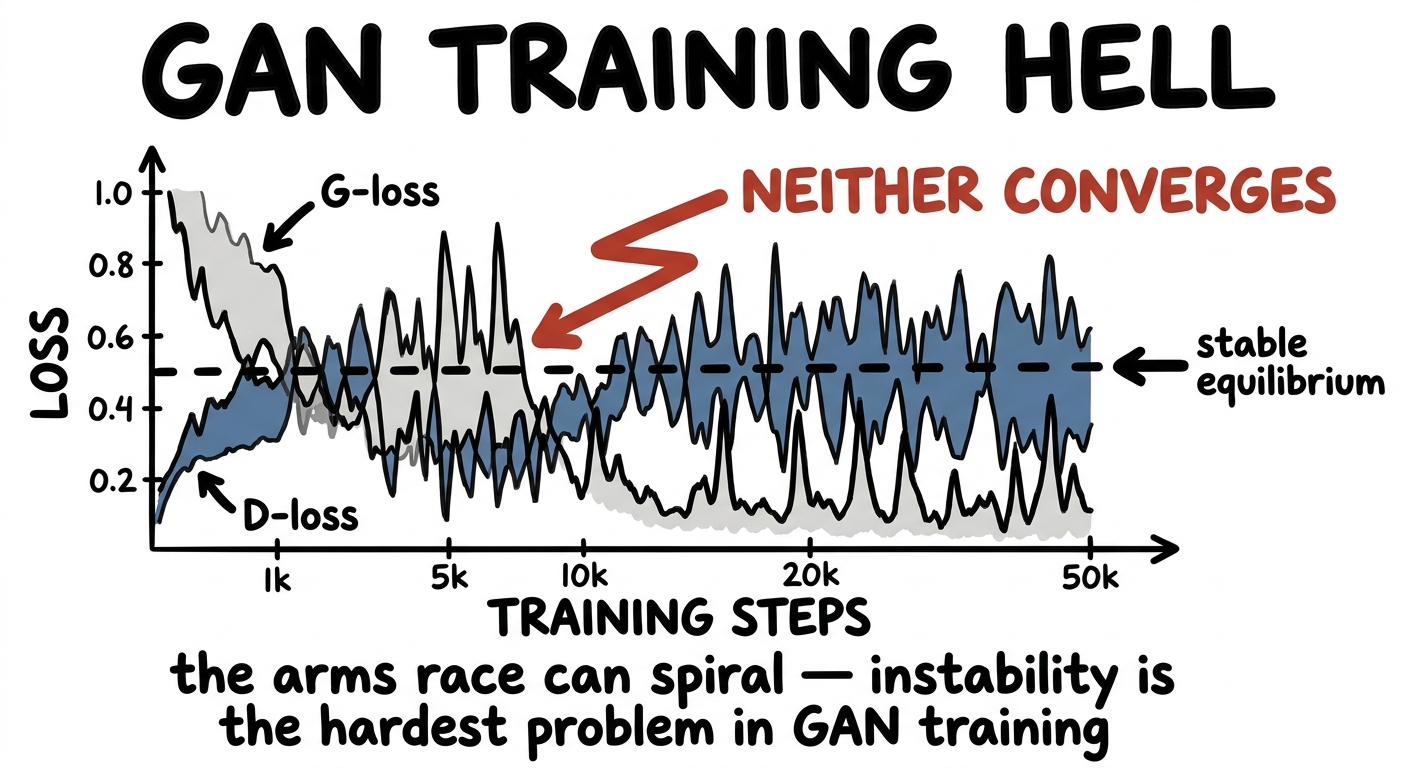
The second hazard is training instability. G and D are supposed to improve together, at roughly equal pace. If the discriminator gets too good too quickly, it gives the generator vanishing gradients — "everything you make is completely fake" is not a useful critique for learning. If the generator gets ahead, the discriminator becomes a pushover and improvement halts. Keeping the two in lockstep is more art than science. It took years of careful engineering — gradient penalties, spectral normalization, Wasserstein distance as a loss, careful learning rate schedules — before GAN training became reliable.
figure generating…
Eight · steering it
Give it instructions
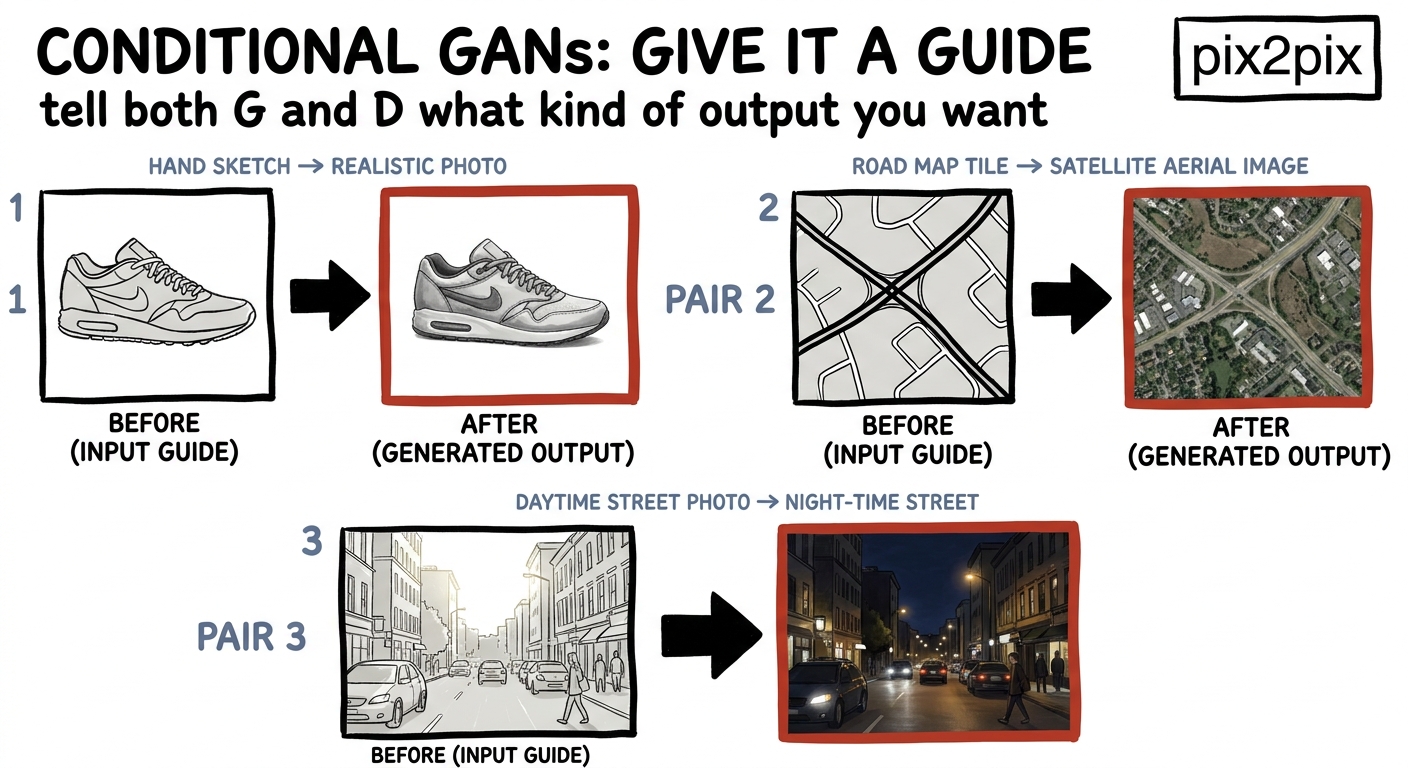
A plain GAN produces random samples from whatever distribution it learned, but you cannot choose what it makes. The natural fix: hand both the generator and discriminator extra information — a class label, a text prompt, or a reference image — and run the adversarial game over "real-and-matching-these-instructions" instead of just "real." This produces conditional GANs, and their power is considerably sharper.
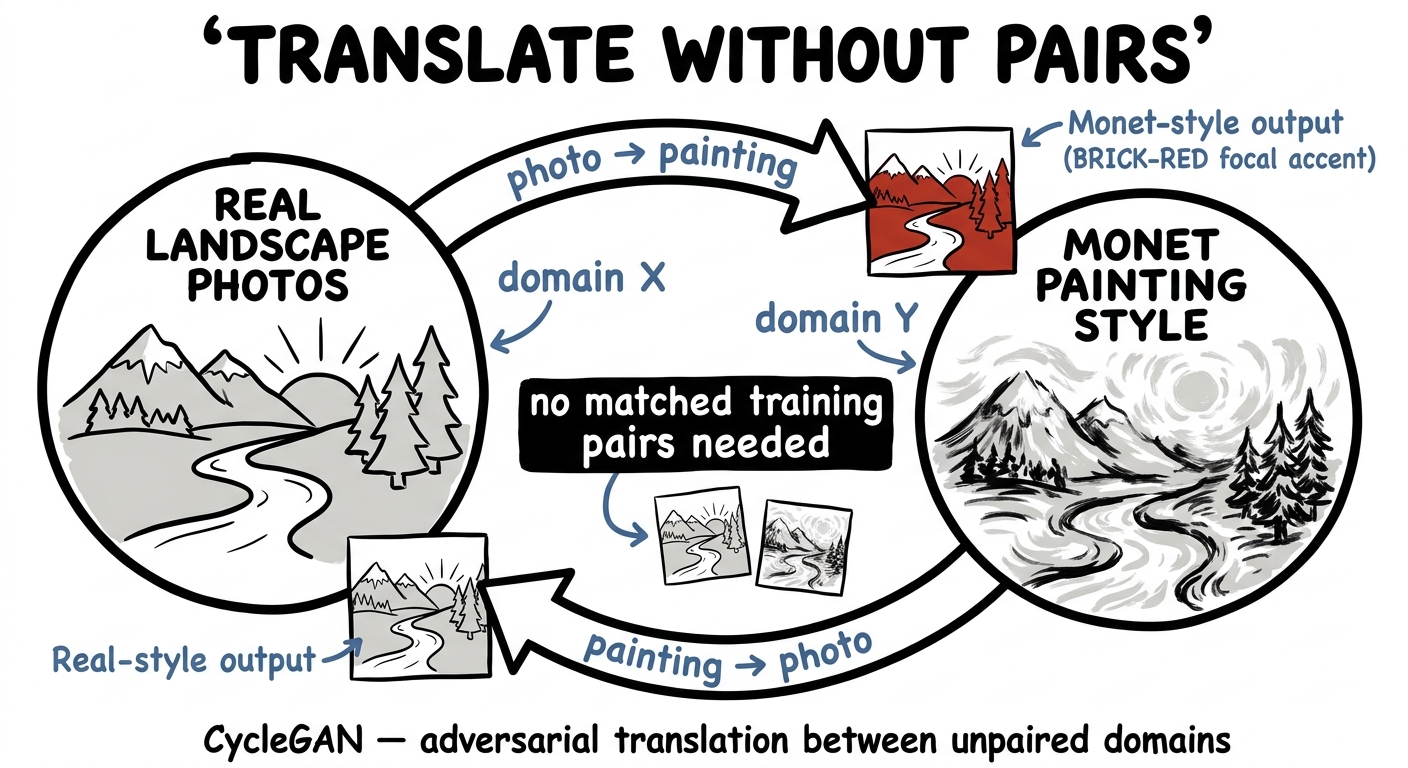
pix2pix frames image-to-image translation as an adversarial game: given a sketch, generate the matching photograph; given a map tile, generate the matching satellite image; given a daytime photo, generate the matching night scene. The discriminator learns what "a convincing matching pair" looks like. CycleGAN removes the requirement for matched pairs entirely — two generators and two discriminators run in a cycle, translating photos to Monet paintings and back, with no paired training data at all, using only the adversarial signal plus a cycle-consistency loss.
figure generating…
figure generating…
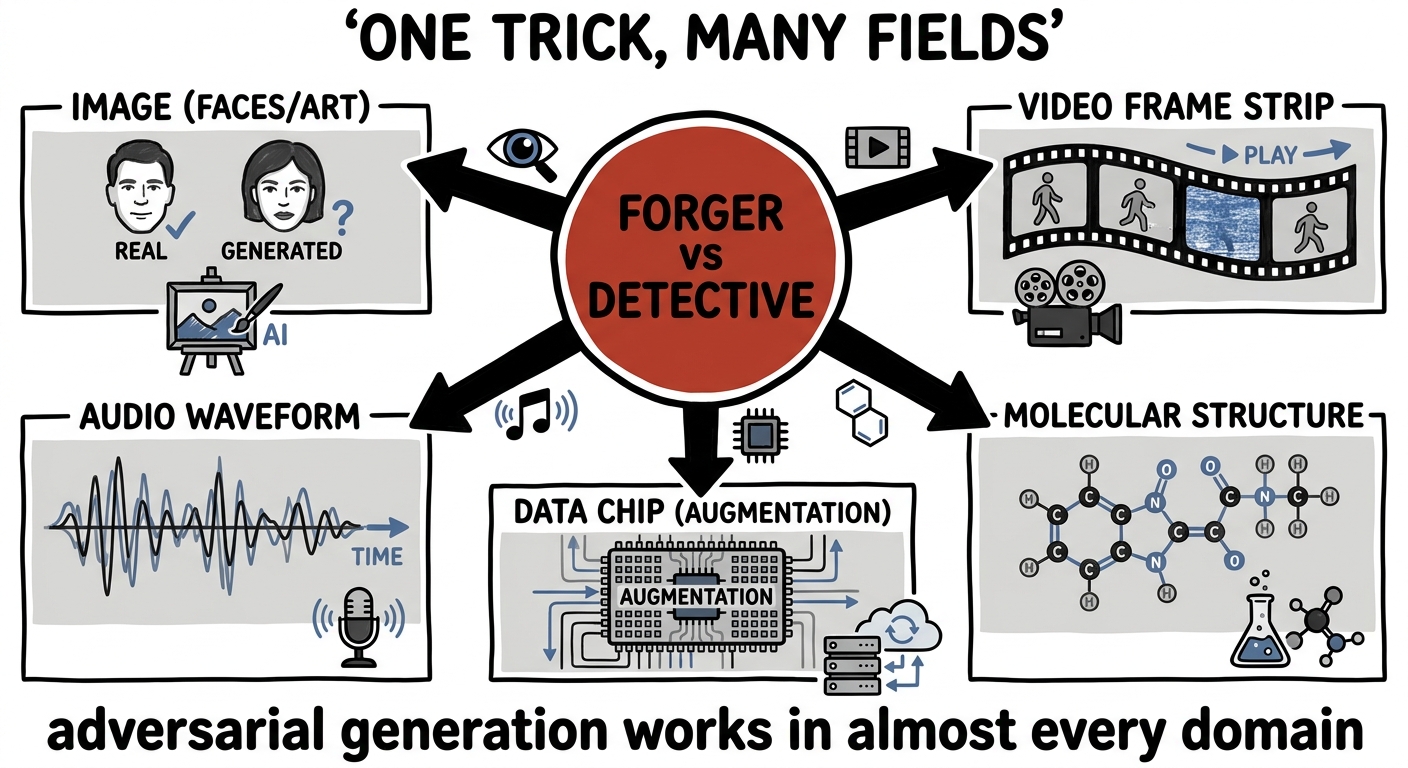
GANs have since spread wherever generation is useful: video synthesis, voice generation, data augmentation for scarce medical images, molecular design. The adversarial framing turns out to be a general-purpose engine for generation in almost any domain where you can show the discriminator examples of "real."
figure generating…
Nine · the non-intuition
You never defined good
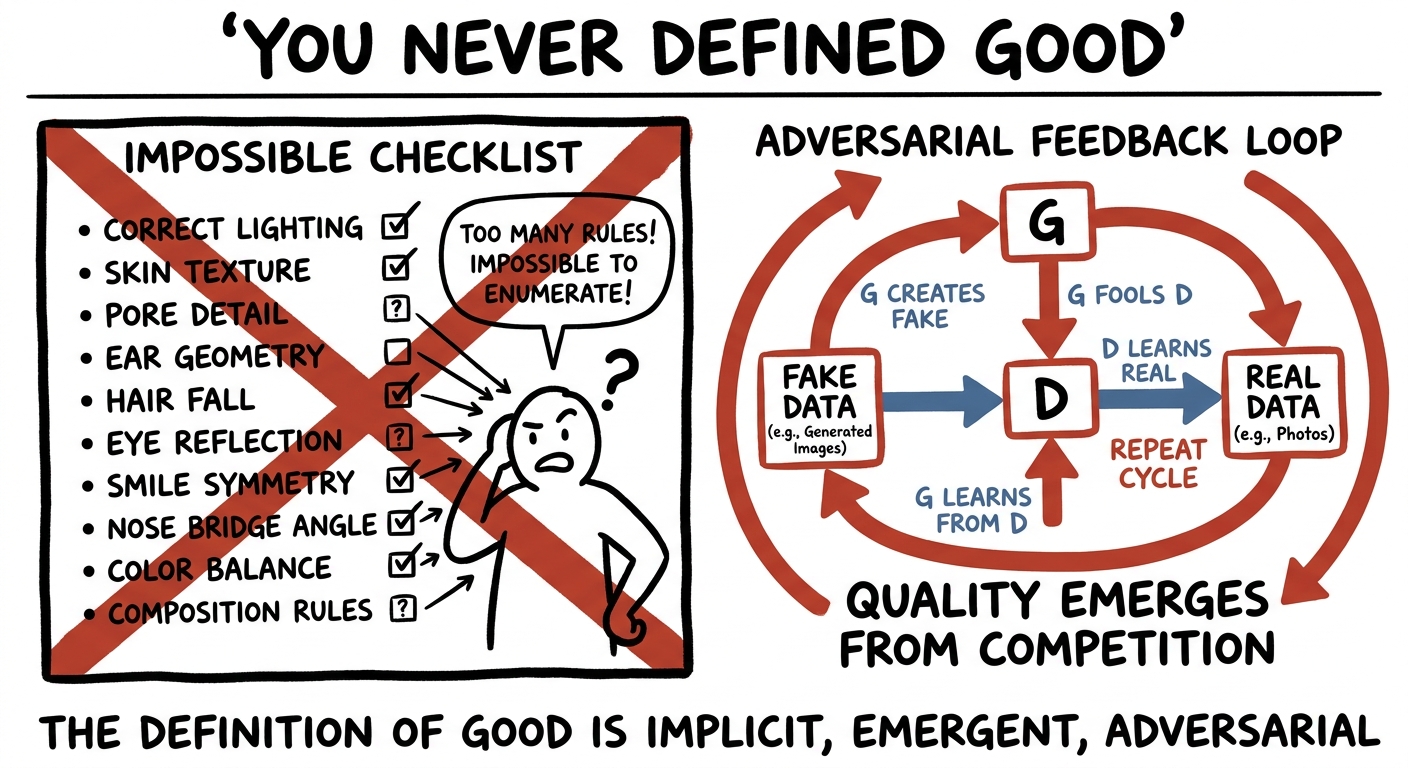
Sit with the strangest thing about this for a moment. When you train a GAN to generate photorealistic faces, you never write down what "photorealistic" means. You never enumerate the rules: correct lighting ratios, pupil reflections, skin-pore texture, ear geometry. You don't have to. The discriminator learns what real looks like simply by seeing real examples. The generator learns what good means simply by trying to fool that learned definition. The specification of quality is implicit, emergent, and adversarial — not programmed.
the deepest non-intuition
You cannot write down what "good output" means for an arbitrary generation task — there are too many degrees of freedom, too many subtle qualities to enumerate. But you can always construct a detector that learns the boundary between real and not-real from examples. The generator then learns to cross that boundary. Quality is a consequence of the adversarial game, not an ingredient of it.
figure generating…
Ten · the move to keep
Competition as curriculum
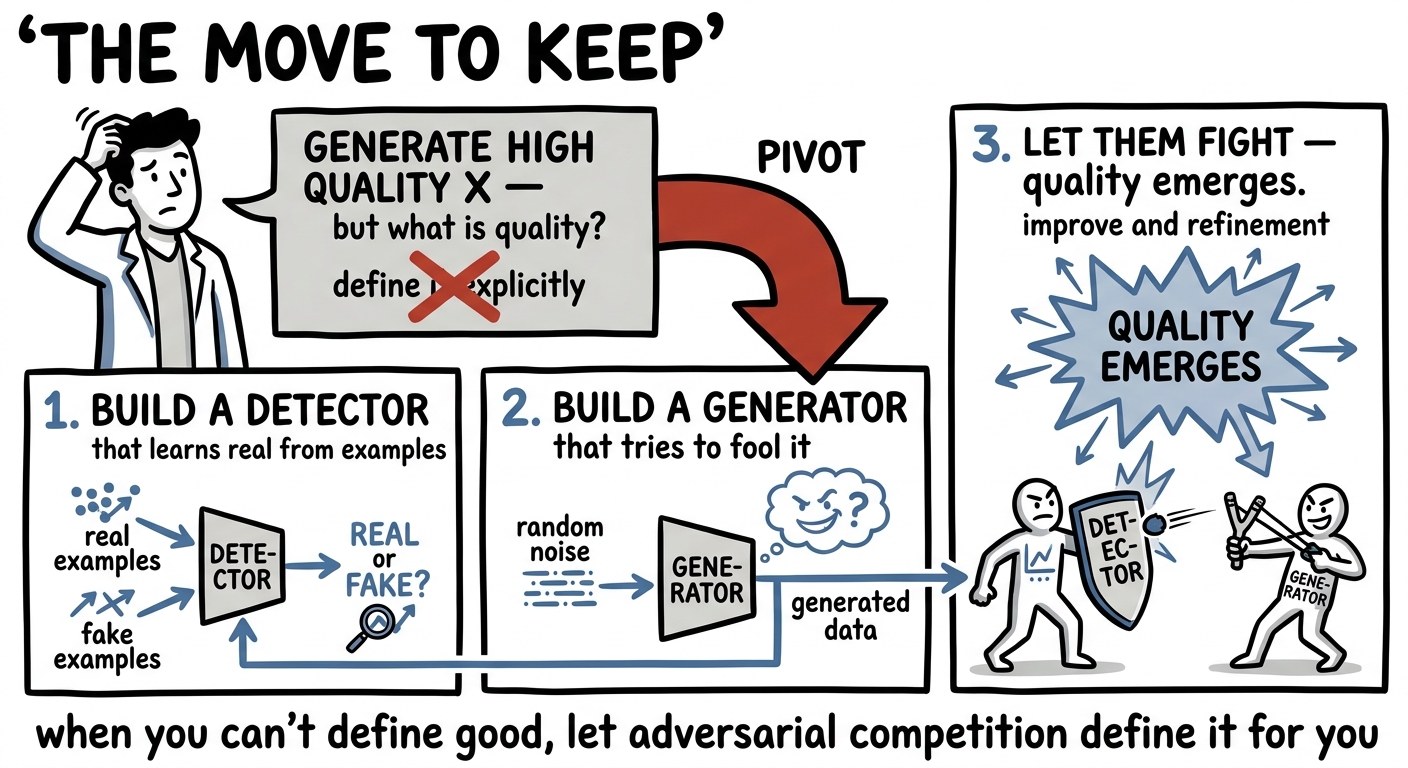
Here is the model to carry forward. When you face a generation problem and you cannot write down what "high quality" means — don't try. Build a detector that learns the real/not-real boundary from examples, build a generator that tries to cross that boundary, and let them train against each other. The curriculum emerges from the adversarial pressure. You do not design it.
figure generating…
The move is broader than GANs. It reappears in self-play — AlphaGo improving by playing versions of itself, each forcing the other to find new strategies. It reappears in red-teaming — language models becoming more robust by having adversarial models probe them for failures. It reappears in RLHF — a reward model trained to judge outputs, a generator trained to maximize that judgment. Wherever quality is hard to specify but easy to recognize from examples, the adversarial frame is available: build a forger, build a detective, let them fight, and let the arms race design the curriculum.
figure generating…
the move to keep
When "good output" is too complex to define directly, you don't need to define it. Build a detector that learns what real looks like from examples, build a generator that tries to fool it, and let adversarial competition write the curriculum. Quality is not an input to the game — it is the output of it.